
K-pop Release Types Explained: Single Album vs. Mini vs. Full Album
Single. Digital Single. Single Album. EP. Mini Album. Full Album. Japanese Single. Mixtape. Labels like these fill our upcoming comebacks list in any given week, and only some of them mean what you would guess. “Single album” is the one that trips people up, because it means something that makes sense only in Korea. Here is the decoder.
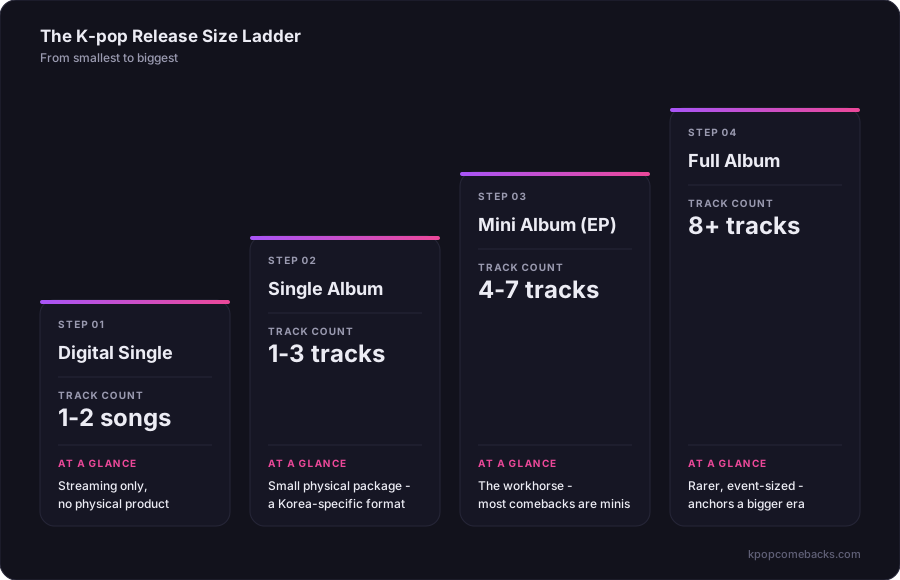
The size ladder, from smallest to biggest
Digital single. One song, occasionally two, released to streaming platforms with no physical product attached. This is the format for one-off songs, seasonal releases, and collaborations — SUNMI’s July 2026 single “Forever July” is one example.
Single album. This is the term that trips up everyone coming from Western pop, where a “single” is just a song. In K-pop, a single album is a physical release — an actual product with packaging and photocards — that carries roughly one to three tracks. It’s a Korean industry format with no real Western equivalent: bigger than a song, smaller than an EP, and counted separately in Korean chart and sales terminology. When the calendar says “Single Album,” expect a small physical package built around one lead song and a B-side or two.
Mini album (EP). The workhorse of K-pop. A mini album typically carries four to seven tracks, one of which is promoted as the title track, and in K-pop usage “mini album” and “EP” are often used for releases of similar size. On our August 2026 calendar, mini albums and EPs form a larger block than any other release-size category.
Full album. Usually eight or more tracks, often well past ten. July and August 2026 provide several calendar examples: fromis_9’s Glow ME (watch the “Vitamin ME” MV on their official channel), Young K of DAY6 with YOUNGEST, KARD’s NOWHERE, NCT 127’s BLINGY and ONEWE’s 面 : Unknown Atlas.
The connective tissue: pre-releases and repackages
Two release types connect one date on the calendar to a larger release cycle.
A pre-release single is a song dropped ahead of the main project to build momentum. You can see the mechanic in real time on our calendar: ARTMS put out “Born Stunner” in late July as a pre-release, with the mini album Hyper-Ego following on August 7. One announcement, two release dates, several extra weeks of attention.
A repackage goes the other direction: the label reissues an earlier album with new material or packaging. It can start another promotion period without being a completely separate full album.
You’ll also spot occasional one-off labels — “special single,” “mixtape” (YOUNG POSSE’s young tape carried that tag in July 2026), “pre-debut” releases and OST singles. These are usually self-explanatory once you know the ladder above; agencies use them to signal that a release sits outside the group’s numbered discography.
The Japanese lane
K-pop calendars also carry releases marked Japanese Single, Japanese Mini Album, or Japanese Best Album. Many established K-pop acts maintain dedicated Japanese discographies — original Japanese-language songs and Japanese versions of Korean hits, released and charted separately from their Korean work.
The format ladder works the same way, just in a different market: aespa’s KISS N TELL was a Japanese mini album, TOMORROW X TOGETHER’s “Setsuna Hanabi” was a Japanese single, and TWICE’s #BEST 2015-2025, released August 26, 2026, was a Japanese best-of compiling a decade of their Japanese releases. A “Japan Edition” tag, meanwhile, usually marks a Japanese edition of an existing album rather than an all-new project.
Why the label matters
The release type gives you a rough expectation for size and tells you whether the item connects to an earlier or later project. It does not guarantee a track count or promotion length; agencies sometimes use different labels for similarly sized releases.
One thing the release type does not tell you is what’s in the box — standard versions, digipacks, platform albums and photocard pools are a separate system entirely, and we’ve covered that in K-pop album versions explained. And if you’re still new enough that the word “comeback” itself is confusing, start with what a K-pop comeback actually is, then keep the calendar handy — these labels appear throughout the schedule.