The LOONAVERSE, Explained: Twelve Solos and a Möbius Strip
Lore-heavy groups tend to attract fans who analyze music videos frame by frame. LOONA’s recurring colors, animals, mirrored scenes and sub-units gave fans enough material for spreadsheets, wikis, and competing schools of interpretation. The later contract dispute then separated that fictional universe from the company that created it.
The 18-month solo rollout
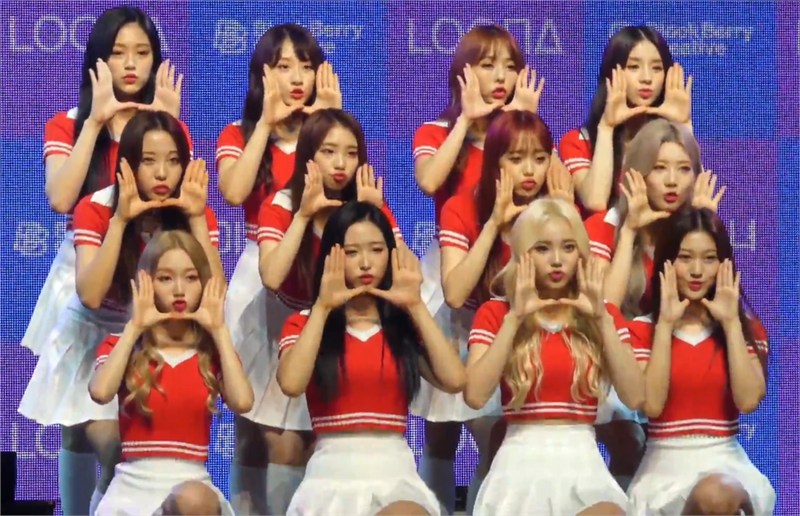
From October 2016 through March 2018, LOONA’s agency introduced the twelve members through solo releases, with sub-unit projects woven between them. LOONA’s official Universal Music Japan profile describes the project as taking about two years before the twelve-member debut in August 2018. Each member was associated with her own color and animal, matching a group whose Korean name (이달의 소녀) translates to “girl of the month.”
By the time the full group debuted, its solo and sub-unit videos already supplied a catalogue of recurring images for fans to connect.
The cosmology
The LOONAVERSE places its twelve characters across three worlds arranged on a Möbius strip:
- Earth — home of the sub-unit LOONA 1/3, the story’s most grounded, innocent register
- The Middle Earth — the in-between realm of Odd Eye Circle, the universe’s rule-breakers
- Eden — the utopia of yyxy, whose story runs through paradise-and-fall imagery
A Möbius strip has only one surface — walk far enough and you return to where you started, inverted. That geometry is the storytelling: timelines loop, mirror images recur, and cause and effect refuse to stay in order.
Built to be argued about
Unlike aespa’s early universe, the LOONAVERSE did not supply one official explanation for every connection. The fandom — Orbit — mapped possible timelines frame by frame across wikis and theory videos. A useful reading therefore separates recurring material visible in the videos from the fan theories used to connect it.
“Butterfly” (2019) extends the video’s focus beyond the twelve members to girls in different places, giving the connected-world reading one of its clearest images.
The ending nobody scripted
The real-world chapter turned darker than any MV. In November 2022, member Chuu was abruptly removed from the group, and within months the remaining members had filed to suspend their contracts with agency Blockberry Creative, citing a broken relationship of trust — including contracts being reassigned without the members’ consent. The members won their freedom — and the group, as constituted, effectively ended.
But here’s the part that belongs in this section: the universe survived. Five members (HeeJin, HaSeul, Kim Lip, JinSoul, Choerry) re-debuted in 2024 as ARTMS, carrying the Odd Eye Circle trio forward under new management; the other five (HyunJin, YeoJin, ViVi, GoWon, HyeJu) regrouped as Loossemble, while Yves and Chuu went solo. The members scattered across new agencies the way their fictional counterparts scattered across worlds.
Their later music now arrives under those new artist names. The calendar, for example, lists HaSeul’s solo single “Afterglow” on September 8, 2026; that release should not automatically be treated as LOONAVERSE canon without official material connecting it.
Where to start
If you want to experience the rabbit hole properly: watch the twelve pre-debut solo MVs in release order, then the sub-unit releases, then debut-era LOONA — and only then read the fan theories. For what “lore” means in K-pop more broadly, start with our pinned explainer: What Is K-pop Lore?