
K-pop Generations, Explained: Who Actually Decides When a New One Starts?
A poll crowns a “4th-gen leader.” A “5th-gen rookie war” breaks out online. Somebody’s favorite gets named the face of their generation. The labels run 1st gen through 5th gen and sound like official taxonomy, which raises an obvious question: who is doing the numbering, and what body decides where one generation ends and the next begins?
Nobody is, and no body does. There is no committee.
Nobody is in charge of this
No industry body, awards show, or agency association maintains an official K-pop generation chart. Korean daily Hankook Ilbo, examining the 5th-gen debate, said it flat out: there is no clear standard for dividing idol generations, so the timing of any changeover is fluid. When rookie groups started calling themselves 5th gen in 2023, an industry PR insider told Kukinews the label was mostly a promotional move. And Nylon, surveying the same argument from the Western side, landed on the most honest description of how the system really works: “it’s largely fans who help dictate the arrival of new generations”.
So the framework is a fan-and-media convention — built from the bottom up, borrowed by agencies whenever it’s useful for marketing, argued about forever. That doesn’t make it useless. It’s genuinely the fastest map of thirty years of K-pop. You just have to hold it like what it is: a map somebody sketched in pencil.
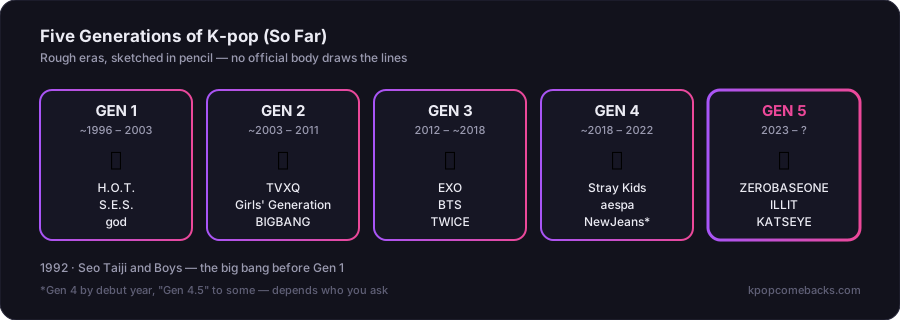
The five-generation map
Generation 1 (roughly 1996–2003). Most histories credit Seo Taiji and Boys — 1992, hip-hop, a clean break from the TV-ballad era — as K-pop’s big bang. But the “first idol generation” usually starts in 1996, when SM Entertainment debuted H.O.T., the first fully produced idol group — cast, trained and packaged under the system every agency still runs on. S.E.S., Fin.K.L, Sechs Kies and god filled out the era. If you’ve never seen where all of this started:
Generation 2 (roughly 2003–2011). The idol system industrialized and the Hallyu wave carried it across Asia: TVXQ — whose debut gets written as 2003 or 2004 depending on the source, so the border fuzziness starts immediately — then Super Junior, BIGBANG, Wonder Girls, Girls’ Generation, KARA and 2NE1. Japan became the second home market, and “Gee” and “Fantastic Baby” became the songs even non-fans could hum.
Generation 3 (2012 to around 2018). By broad consensus the clock restarts with EXO in April 2012, followed by BTS (2013), TWICE and SEVENTEEN (2015), and BLACKPINK (2016). What actually changed, as the Korea Herald’s own generations explainer puts it, is that these groups “used social media and YouTube as primary means to promote themselves” — which is how fandom went properly global, and how “Growl” and “Spring Day” ended up soundtracking fans who had never once watched a Korean music show.
Generation 4 (roughly 2018–2022). Here even the start year is contested: some sources begin at 2018 (Stray Kids, ATEEZ, (G)I-DLE), some at 2019 (ITZY, TXT), some at the pandemic (aespa and ENHYPEN, 2020). Whatever the border, the traits are clear enough: global-first debuts, online concerts, and universe marketing running at maximum — the generation of aespa’s KWANGYA and “Next Level”, of “God’s Menu”, of IVE, LE SSERAFIM and NewJeans. Keep NewJeans in mind — we’re coming back to them.
Generation 5 (2023–?). This one didn’t emerge; it was announced. When ZEROBASEONE debuted in July 2023, Mnet and their label pushed the “first 5th-generation group” line hard enough that fans openly called the branding forced. It stuck anyway. By early 2025, Korean media was billing the SM-versus-Starship rookie face-off between Hearts2Hearts and KiiiKiii as a “5th-generation girl group showdown” without blinking, and the roster now runs through RIIZE, ILLIT, TWS and KATSEYE — whose “is this even K-pop?” debate is a whole story of its own.
The border disputes are the best part
If no one is in charge, the edges can’t be clean — and they aren’t.
The NewJeans problem. By debut year (2022), Korean media files NewJeans under gen 4 — SBS literally headlined them “4th-gen NewJeans” while rolling its eyes at premature 5th-gen talk. But their sound and rollout felt like such a break that Nylon placed them in “the nebulous space between K-pop’s current fourth generation and fifth” — generation 4.5, in effect. Both descriptions are in print. Both are “right.” There is no referee to appeal to.
Half-generations are older than you’d think. Korean critics have used in-between labels for years — the webzine Idology’s 2020 generation survey treats 1.5 gen (Shinhwa, god, BoA), 2.5 gen (SHINee, 2PM, INFINITE) and 3.5 gen (SEVENTEEN, MONSTA X, BLACKPINK) as regular chapters of the story, not footnotes. And in October 2025 the magazine Arena Homme+ went ahead and published a “5.5-generation idol encyclopedia”, rounding up roughly 46 groups that debuted between late 2024 and 2025. Whether anyone else adopts “5.5” is an open question — so far it’s mostly that one headline.
The CORTIS case. In April 2026, one Korean outlet grouped rookie boy group CORTIS under the 5th generation. Two months later, another declared that CORTIS had opened “the era of the 6th generation”. Same group, same year, two different generations, two straight-faced articles. That’s the whole system in one anecdote: every outlet is its own referee.
What actually flips a generation
Notice that the borders people argue about always sit on top of industry shifts, not calendars. Gen 1 begins with the invention of the trainee system. Gen 3 begins when promotion moved to YouTube and social media. Gen 4 begins somewhere in the shift to global-first strategy. Gen 5 — well, what gen 5 begins with is precisely the argument. Debut year is just the shorthand fans use to apply a label quickly, which is why two groups from the same year can feel eras apart, and why the arguments never end. Hankook Ilbo’s framing is the cleanest one: a changeover counts when a cohort’s shared traits clearly break from the previous generation’s — and people disagree, in real time, about whether a break is happening.
Generations coexist — that’s the point
One last fix to the mental model: generations aren’t a relay race where the old one leaves the track. god — gen 1, debuted 1999 — sold out every seat of their December 2025 full-group arena run, twenty-six years in. SEVENTEEN just re-signed with their label, all thirteen, for the second time. And the same monthly calendar that lists their comebacks lists rookies whose generation number hasn’t even been agreed on yet.
Use the labels the way the fans who built them use them: a rough map for navigating thirty years of history — not a rulebook, because nobody ever wrote one. And the upcoming page keeps the full running list of what every generation is releasing.